

Destination Sunday: Trust Is Being Decided Before The Trip
The part of the guest experience destinations often overlook

Trust Is a Destination Responsibility, Not a Booking Channel
There’s a moment that happens before a guest ever reaches a front desk.
They’ve exited the highway, they’re circling for parking, and they’re squinting at signage that assumes they already know how things work here. Nothing has gone wrong yet, but nothing feels settled either.
That’s often the moment when a guest decides, consciously or not, whether this place feels easy… or like work.
Disorientation doesn’t start at check-in. It starts at the edge of a place.
(What follows reflects patterns seen repeatedly across destinations and operators. It’s grounded in practice, not lab-grade causality.)
This Isn’t a Guest Problem
Across destinations — large and small, urban and rural, seasonal and year-round — many operators are seeing the same pattern. Guests feel more on edge. Small issues escalate faster. Situations that used to be minor now feel charged.
Different settings. Similar behavior.
What’s changed isn’t that guests suddenly forgot how to behave, or that operators forgot how to do hospitality. A major part of what has changed is the runway. Booking windows are tighter. Trips are shorter. Arrivals are more compressed.
Layered on top of that are other pressures destinations recognize well: cost volatility, staffing constraints, infrastructure gaps, and a general rise in travel stress.
When that buffer shrinks, tolerance often shrinks with it. This isn’t entitlement. It’s pressure.
Why OTAs Feel Easier (And Why That Matters)
Let’s talk about the elephant in the room without throwing tomatoes.
For many guests, OTAs still feel safer at the moment of booking. Not because people love them, but because they reduce uncertainty. They standardize information, create predictable flows, and answer the “what happens next?” question quickly.
They aren’t warm or personal or particularly inspiring. They’re predictable.
And when people are already stressed, predictable often beats personal.
That doesn’t make OTAs villains. It makes them very effective billboards.
The problem isn’t that guests start there.
It’s what happens after.
Where the Handoff Breaks
A guest leaves an OTA environment feeling oriented enough to commit, then arrives in a destination that assumes local knowledge, spreads information across too many places, and shifts from guiding language to promotional language.
Welcome to town. Figure it out.
That gap is where trust starts to wobble.
In many places, when destinations don’t help hold that orientation moment, operators inherit it. Front desks become translators. Visitor centers field questions they didn’t create. Hosts become wayfinding systems.
Over time, reviews and complaints quietly reflect destination-level friction that had little to do with the room, the host, or the stay itself.
The billboard worked.
The hosting didn’t start.
A Shared Orientation Changes the Experience

We’ve seen this handled differently at the destination level.
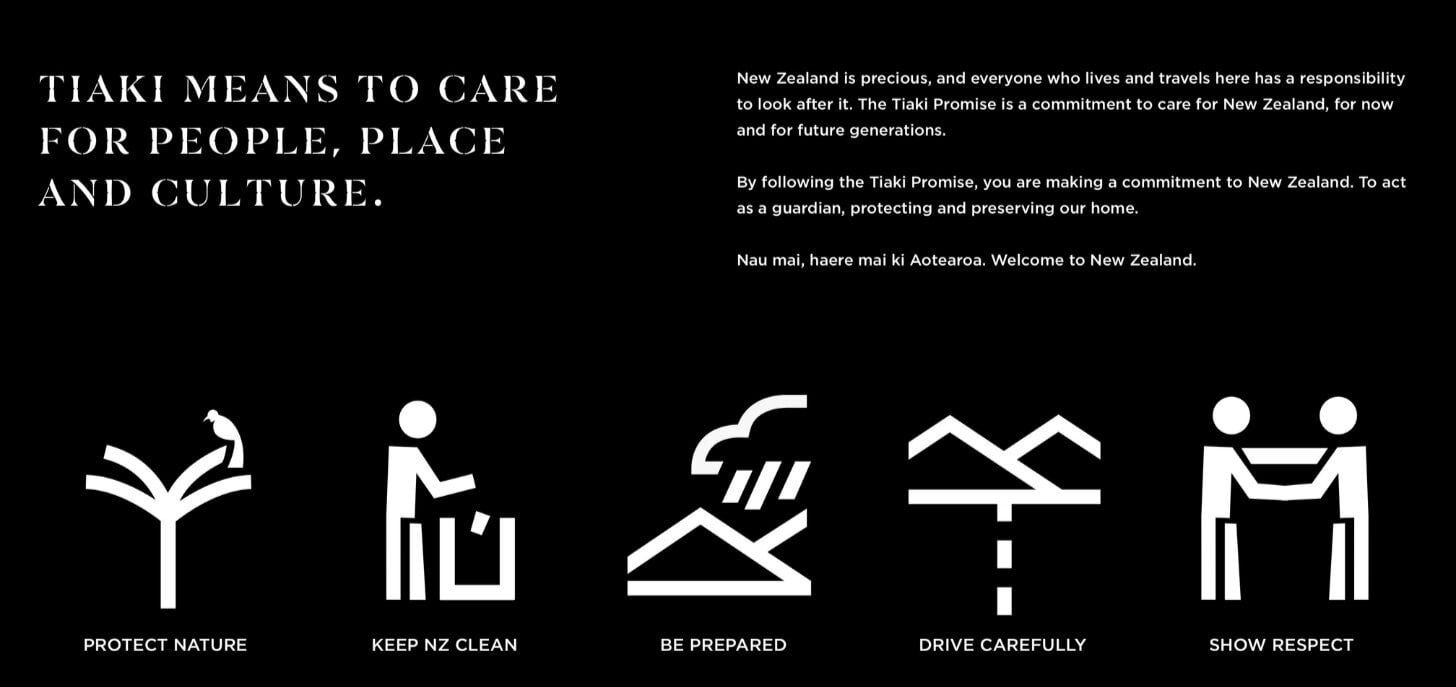
New Zealand’s Tiaki Promise is a useful example. Rather than leaving orientation entirely to individual businesses, the destination established a shared set of expectations about how to travel responsibly, what’s valued, and how the place works.
It doesn’t guarantee perfect behavior. What it’s designed to do is reduce surprise and misaligned expectations before visitors arrive.
And when expectations are clearer, moments that escalate tend to become easier to manage.
A Reflection for Destination Leaders
This isn’t a task list.
It’s a lens.
You, as a destination organization or leadership team, are uniquely positioned to see where confusion originates, even when you don’t control every touchpoint.
Take a moment to consider:
Where are visitors being asked to figure things out on their own, and who absorbs that confusion downstream?
As you reflect, you may notice:
Messaging that assumes local knowledge
Information that exists, but not in the order visitors experience it
Operators translating expectations the destination never clearly set
You don’t need to solve everything at once.
Even identifying one shared moment of uncertainty — arrival, parking, wayfinding, local norms, or “what happens next” — can shift how trust is experienced across the entire destination.
Alignment doesn’t require control.
It starts with awareness.
A Necessary Reality Check
Let’s be clear about what trust does and doesn’t do.
Building trust does not guarantee direct bookings. Anyone telling you otherwise is overselling or hasn’t worked in travel long enough.
What trust does create is permission: permission to explore beyond the OTA, permission to click through, and permission to believe that booking direct won’t be risky.
In practice, it often looks something like this:
Disorientation at arrival creates stress.
Stress pushes guests toward whatever feels most predictable.
Predictability pulls them back toward platforms and intermediaries that promise protection.
That’s not a moral failure. It’s human behavior.
Trust doesn’t interrupt that pattern overnight. But it does change where gravity starts to pull over time.
Some guests will always book on OTAs. Habit matters. Convenience matters. Loyalty programs matter.
That’s not failure. That’s reality.
What Destinations Can Influence (Without Controlling Everything)
This is where destination organizations often have more leverage than they realize.
Not because you control every experience, but because you convene the system.
Orientation lives in places DMOs touch every day:
Arrival signage and wayfinding
Parking explanations and transit guidance
Pre-arrival emails, confirmation pages, and visitor FAQs
Shared language operators reuse in their own messages
Automated replies, chatbots, and after-hours scripts that speak before a human does
Increasingly, systems — including automation and AI — set expectations long before a human ever enters the picture.
Most guests don’t need more scattered information. They need clearer context and sequence. They want to know what’s normal here, what won’t be a problem, and where a human fits when something goes sideways.
Price, convenience, and loyalty still matter. Direct begins to win when it also feels at least as safe and predictable.
That sense of safety comes from clarity, not charisma.
The Role Shift Destinations Are Being Nudged Into
Whether you asked for it or not, as a destination, you’re being nudged into a hosting role.
OTAs can bring people to the door. Destinations help decide whether guests feel held once they arrive.
That doesn’t mean you own every experience. It means you help align the moments that matter most, so operators aren’t absorbing confusion alone.
When that alignment exists, guests feel steadier, operators feel supported, and the destination earns trust without having to shout for it.
The Part That Shows Up Later
Trust isn’t a booking tactic. It’s a responsibility that has been quietly moving upstream.
Every confusing sign, vague instruction, or “check three different websites” moment nudges guests back toward whoever feels safest, even when the stay itself is excellent.
Right now, the destinations that understand this aren’t arguing about channels.
They’re investing in alignment, clarity, and shared expectations — the unglamorous work that makes everything else easier.
That’s where the real work usually starts.
Where does a first-time visitor to your destination have to guess instead of being guided?
Further reading
For readers who want deeper context on some of the ideas referenced in this article, these resources provide useful background and industry perspectives:
Wow, the point that 'This isn't entitlement. It's pressure' realy resonated. You perfectly captured the human element behind travel stress. Such a smart observation.