

Your Staff Already Knows. The Question Is Whether They’ll Tell You.
One conversation that changes what your team tells you

The Question Nobody Asks First

Your team already knows what’s confusing your guests. The question is whether they’ll tell you the real list or the version that won’t get them in trouble.
Before you ask your team anything this week, try this:
Name one thing about your property that isn’t working, something you built or chose, and say it out loud to the person who’s at the property when you’re not.
Not in a meeting. In passing.
What they add to your observation is more honest than any survey you’ll ever run.
The Napkin Test isn’t the problem
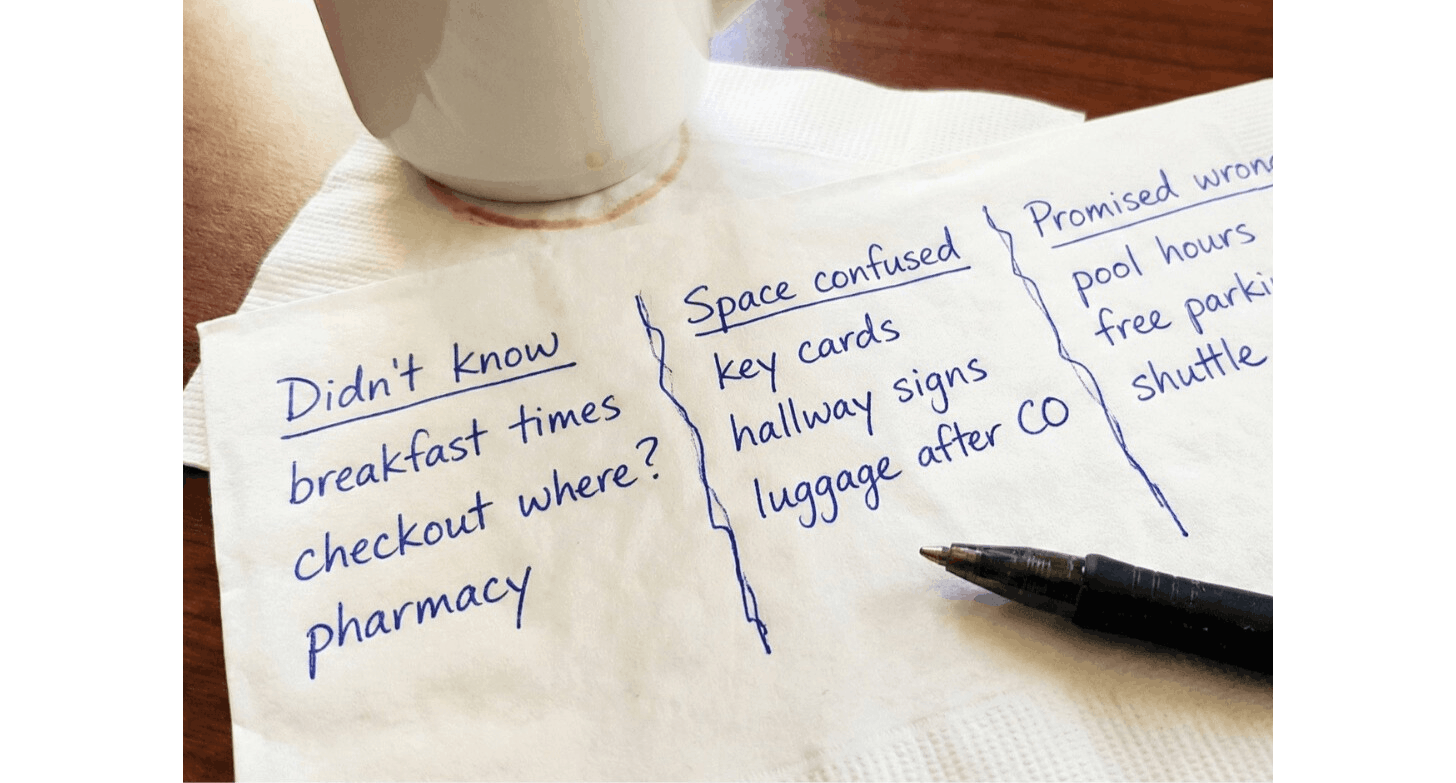
Monday’s article introduced the Napkin Test: ask your staff what confuses guests, sort the answers into three columns (information problems, design problems, expectation problems), and you’ve got a priority list.
One reader nailed it: “The Napkin Test only works in places where people feel safe enough to answer. In some hotels, staff know what’s broken. They’ve learned not to say it.”
That’s the part nobody talks about. You can have the best tool in the world. If your team doesn’t feel safe answering honestly, it won’t work.
What holding back looks like
Your team isn’t lying to you. They’re picking and choosing. You do this too, by the way. We all do.
When you ask “what’s confusing guests?” someone on your team who doesn’t feel safe will still give you real answers. The parking sign. The wifi password confusion. The fact that breakfast hours aren’t on the website. All true, all fixable, all safe to name.
What they won’t mention is the listing description you wrote that doesn’t match reality. The pricing structure that confuses repeat guests. The process you built that creates more questions than it answers. Those stay in their head, because raising them feels like criticizing the person who asked.
Here’s the tell. You get a napkin full of real problems. It looks complete. It isn’t. Everything on it points outward: the OTA, the tourism board, the city’s parking. Nothing points inward at your own decisions. That’s not deflection. It’s self-protection.
This isn’t rare. Researchers found 85% of workers have held back something important from a boss. Not because they’d get fired. Because they’d get seen differently.
In a property where your team is three people, and you work side by side every day, the cost of being seen differently is real. It’s tomorrow’s shift. So people stay helpful, polite, and quiet.
Meanwhile, you’re promoting an experience that isn’t quite what guests are actually living.
Why going first works
People don’t speak up because you told them they could. They speak up because you went first.
You’re not asking them to be brave. You’re showing them what it looks like to name your own blind spot out loud.
“I’ve been thinking the check-in instructions I wrote are confusing people. You see it more than I do. What do you think?”
That tells your team more about what’s safe to say than telling them “you can always come to me” ever will.
And when the honest answer is “I can’t fix this yet, here’s why”? That still counts. What breaks trust isn’t the problem you can’t fix. It’s when something gets raised and disappears into silence.
This week, do this: Go first.
Then listen.
What they add to your observation is your first honest napkin item. Monday’s article shows you what to do with it.
Your trigger: The first time I see my team today, I’ll name one thing that might not be working before I ask what they’ve noticed.
Here's how AI could help you with this
Once you have the honest list, this helps you sort it.
Paste this into any AI tool:
“Here are the things my staff said confuse guests: [paste list]. How many point to problems I control (my processes, my messaging, my listing, my space) versus problems caused by outside forces (the destination, the OTA, the city)? If most point outward, suggest three inward-facing questions I could ask to surface the gaps they skipped.”
The person who knows where your guest experience breaks may not be here next season if they’ve decided it’s not worth raising.
Monday’s Napkin Test gives you the method. This week, find out whether the people closest to your guests feel safe telling you the truth.
If you missed Sunday’s piece on destination coordination or Monday’s Napkin Test article, both connect to this:
Try this once this week. You’ll surface one problem you didn’t know existed.
If you try this, hit reply and tell me what happened.
I didn't learn this from a book. I learned it from years of my staff telling me something wasn't working and me doing nothing, or being afraid to tell me because I'd get upset.