

Why Your Hotel Might Be Hard for AI to Find
From the Front Lines of Hotel Distribution

A guest opens Google’s AI chat, types “Find me a cozy place for a long weekend in Portland with parking and great coffee nearby,” and a few messages later, they’re looking at options pulled from live hotel data. In some early integrations, the booking completes right there. In most cases today, the AI narrows the list and the last click still lands on Google Hotels, an OTA, or your booking engine. Either way, the conversation is what drove the choice. I’ve been running the same kinds of searches guests run. The pattern is plain: the tools reward specificity. Sometimes your website never enters the picture.
At the same time, you’re still getting calls where guests say, “I saw you on Booking.com but couldn’t find your website,” and you end up paying commission on people who clearly wanted you anyway. That stings when margins are already thin.
If you’re running a 10–20‑room place with a tiny team and a never‑ending to‑do list, this feels like one more thing you don’t have time for. You still have rooms to turn, staff to schedule, and guests who want extra pillows.
This isn’t a trend report. It’s just what I’m seeing. And it made me ask one question: What’s the least I can do this year to stay visible?
This is what protecting direct bookings looks like now.
TL;DR:
Clean your facts. Turn extras into products. Make vendors prove they’re future-ready.
The line you need to sit with: The first thing you’ll notice isn’t fewer bookings. It’s more expensive bookings. That’s what happens when demand shifts to higher-commission channels. You’re just as busy, but keeping less.
This isn’t a crisis today. But the hotels that clean this up in 2026 will have a real edge by 2027. The ones that wait will pay to catch up.
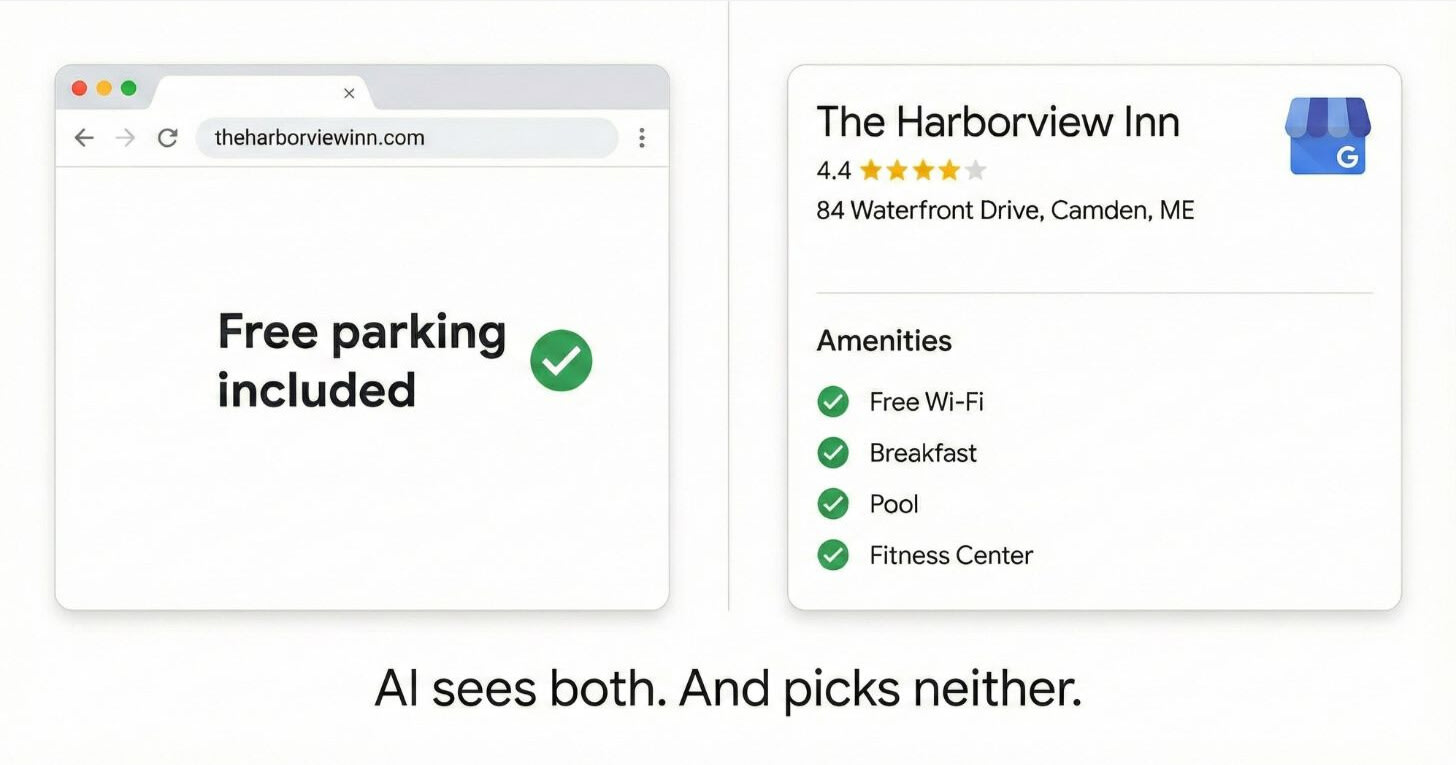
Quick check: Open your Google listing and your website side by side. Do they describe parking, pets, and breakfast the same way? If not, start there.
If your own listings don’t agree, guests don’t know which one to trust.
Your 12-Month Survival Plan (The Short Version)
If you only do four things this year, make them these, especially if you have 10–20 rooms and a tiny team. One per quarter. Not all at once.
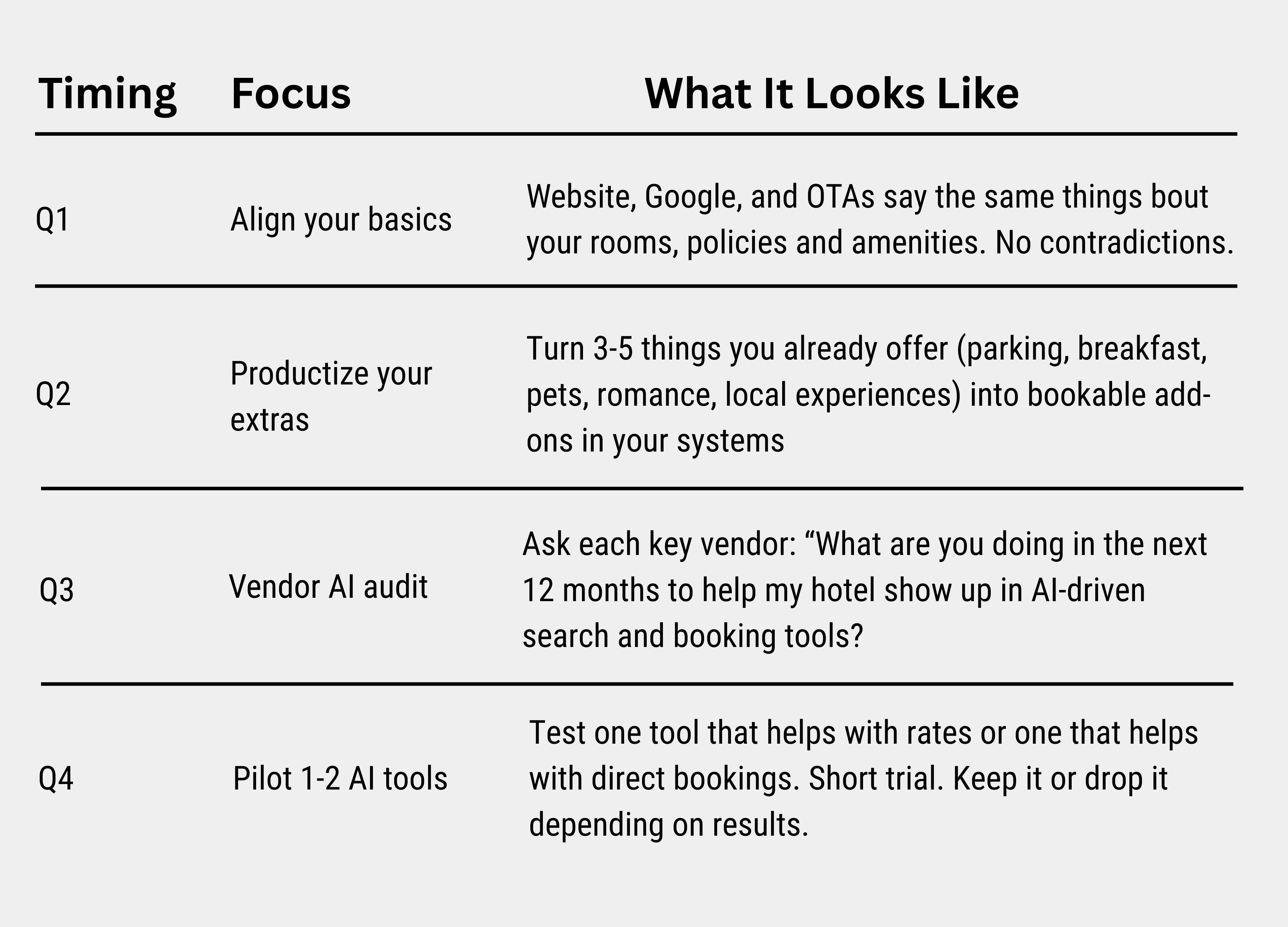
How to know if you’re already in decent shape: If your website, Google listing, and top OTA describe the same room the same way, you’re ahead of most independents.
If you’re running on fumes, screenshot that table and come back to the rest when you have more energy. Here’s why each one matters, and what to do when you sit down to actually fix it.
What Triggered This: The Marriott-Google Signal
For the first time, search, recommendation, and booking are happening in the same conversation. Marriott has begun piloting an integration with Google that lets selected properties be found and booked directly inside AI Mode. A guest describes what they want. The AI shows options and completes the booking. No website visit required.
Small pilot. Big signal. Where does your hotel show up in that conversation?
Why This Matters to Smaller Hotels
This isn’t mainly about Marriott. It’s about how AI tools are starting to see and choose places to stay.
Here’s what I keep seeing across vendors and client calls:
Structured data matters. Structured data simply means your hotel facts stored in specific fields in your systems: room type, view, bed type, balcony, breakfast, parking, pet policy, and so on. Not buried in long descriptions. Tools lean on clean facts, not your prettiest paragraph. You already have most of this. It’s just messy.
Consistency across sources matters. When your website, Google listing, and OTAs don’t tell the same story, you’re harder to trust and easier to skip.
Set up for AI means your rooms and offers are described so tools can read, compare, and book them through the connections your vendors already provide: your PMS (property management system), CRS (central reservation system), booking engine, channel manager, and Google.
AI isn’t reading your story. It’s checking your facts. If the facts are fuzzy, you don’t make the shortlist.
When an AI answers “Where should this person stay?”, it’s scanning for: room types and configurations, what’s included, price and restrictions, location and nearby points of interest, policies (cancellation, pets, parking), and perks or add-ons that create extra value.
If your info is thin, inconsistent, or scattered, you’re less likely to show up, even if guests love staying with you.
In real projects, I’ve watched small, well-run independents with strong content and clean data appear ahead of bigger brands. I’ve also seen good properties get buried simply because their information is messy or incomplete.
The math: If 10% of your bookings shift from direct to OTA, that’s thousands a year in commissions for the same rooms. Same guests. Less money kept.
The Big Idea: Your “Digital Shelf”
Across different tools and vendors, I keep seeing the same pattern: the hotels that do best in this new world treat their information like a product catalog, not an afterthought. Rooms and offers aren’t vibes. They’re items on a shelf.
“King Room” isn’t a product. “Top-floor king, balcony, harbor view, parking included” is.
In practice, this means one reliable source for: room types and configurations, rates and restrictions, photos, descriptions, amenities, policies (cancellation, pets, parking, etc.), and add-ons and experiences (breakfast, parking, tours, spa, etc.).
All of it feeding your website, booking engine, channel manager or CRS, Google Business Profile, OTAs, and the AI-driven features those platforms are rolling out.
The cleaner that shelf is, the easier it is for both human guests and AI-assisted tools to understand, compare, and present your property.
What’s Changing, and What’s Not
What’s shifting: More guests will use conversational tools (Google AI Mode, other AI assistants) to find places that match specific needs and budgets. Those tools act like a first filter, deciding which hotels to show based on the data they can access. A guest who types “pet-friendly hotel with parking near the waterfront” gets a shortlist built from organized facts, not from who has the best homepage copy. A family searching “two-bedroom suite with kitchen, walking distance to beach” will see whoever described that room type in their system, not whoever wrote the most persuasive paragraph. If you didn’t describe it, the AI assumes it isn’t there. Your content and data quality are becoming as important as your ad spend and website design.
What’s not changing: Guests still care about cleanliness, comfort, safety, and value. Independent hotel guests in particular say they value personalization, local character, and service. AI changes how guests find and evaluate you; it doesn’t replace the on-property experience you deliver.
Your 12–24 Month AI Action Plan (The Deep Dive)
Most hotels are experimenting with AI in limited ways but haven’t fully baked it into distribution and marketing yet. You don’t have to be ahead of the curve overnight.
Think of this as: one weekend task, a few vendor calls spread over the year, and a handful of small changes to how you set things up.
Step 1: Align Your Core Facts Everywhere
(Effort: one half-day with you and/or a trusted staff member)
Start with your basics. Not sexy. It works.
Make sure your website, Google Business Profile, and OTAs match on: name, address, phone, check-in and check-out times, parking, pets, Wi-Fi, and cancellation policy.
Clean up visuals and copy. Current, honest photos of rooms, bathrooms, public spaces, exterior. Simple, specific descriptions:
Before: “Nice king room with view.” After: “Top-floor king room with balcony and harbor view.”
Before: “Standard double.” After: “Ground-floor double room with step-free access from parking, good for limited mobility.”
You don’t need a new website to do this. A few focused edits to your existing pages often move the needle.
Step 2: Turn 3–5 Extras Into Real Products
(Effort: one working session with your PMS, CRS, or booking engine provider)
Many hotels already offer extras but don’t represent them as structured, bookable items. More and more tools are built around those extras being explicit products.
Here’s where this gets real: I’ve talked to hoteliers whose front desk answers the same parking question five times a day because the website says “parking available,” the OTA says nothing, and the booking confirmation doesn’t mention it.
That’s not just an information problem. It’s staff time, guest confusion, and bookings that almost happened but didn’t.
When information is broken, your team fills the gap with their voices.
Write down what guests already pay extra for or ask about: early check-in or late checkout, parking, breakfast, F&B credits, dining packages, romance or celebration touches, local experiences (tours, tickets, rentals), pet fees and amenities, workspace add-ons, meeting rooms, day-use offers.
Then, with your vendor, set up a few as bookable add-ons:
Before: “Romance package” mentioned in a paragraph. Guests must call or email.
After: “Romance Package” in your booking engine with:
Name: Romance Package
Inclusions: bottle of sparkling wine, late checkout, rose petals
Price: defined per stay
Availability: Friday–Sunday, select room types
Easier to book. Easier to upsell. Less back-and-forth. It also means your team stops answering the same questions manually.
Start with 3–5 things you already do that guests love.
If you’re a small inn or hotel property with a small team, Steps 1 and 2 are the moves that matter most right now. Do those two and you’re ahead of the majority of independents. Steps 3–5 are worth doing over the rest of the year, but they can wait until you’ve handled the foundation. Come back when you’re ready.
Step 3: Ask Vendors the AI Questions
(Effort: one call per vendor, spread over the next few months)
This is the line I keep coming back to: you don’t have to build the tech yourself, but you do have to ask better questions.
A note before you pick up the phone: Most vendors won’t have perfect answers yet. You’re not behind for asking. The point isn’t to quiz them. It’s to find out who’s thinking about this and who isn’t. That tells you a lot about where to invest your time and money over the next year. If your vendor answers with buzzwords and no examples, that’s your answer.
Talk to your booking engine provider, channel manager or CRS, PMS, and website or digital agency.
Ask them:
“How are you preparing to connect my property to AI-driven search and booking (Google’s AI, other AI trip planners, etc.)?”
“Can you give me one clean source of truth for my rooms, rates, content, and add-ons that all channels pull from?”
“How do you keep my content structured and up to date across Google, OTAs, and my website?”
“What should I do in the next 12 months to be more visible in AI-driven search using your tools?”
Listen for specifics. Roadmaps, existing integrations, and concrete recommended actions are positive signs. Vague answers with no timeline may indicate a vendor that is still catching up.
You don’t have to switch tomorrow. But this should shape who you renew with.
Step 4: Pilot 1–2 Practical AI Tools
(Effort: small tests you can turn off if they don’t help)
Here are a few realistic use cases other independents are exploring:
Rates and demand: A tool that suggests rate changes based on demand and events, while you retain final approval.
Direct bookings: A booking engine that helps guests narrow their choices and suggests upsells. A simple site assistant that answers common questions and keeps guests from leaving to “go compare.”
Start with free trials or short pilot periods and basic A/B comparisons where possible.
If it doesn’t help guests choose you or save your team time, drop it.
Step 5: Use Guest Data to Create Real Loyalty
(Effort: small ongoing habits)
Across reports and real-world case studies, one theme keeps repeating: first-party guest data and email relationships get more valuable as third-party channels and algorithms get more complex.
Keep guest emails, stay history, and simple notes (e.g., “anniversary,” “business,” “family”) in one place, even if it’s just a basic field or tag in your PMS.
Make it easy to spot repeat guests and high-value types (corporate, event, long-stay).
Then put that to work: make direct bookings better with preferred rooms, flexible check-in, small credits or perks. Match offers to what you know. A returning couple marked as “anniversary” gets a romance add-on offer. A repeat business guest gets an early check-in or workspace-related perk.
Now both guests and AI can see why booking direct makes sense.
What About Short-Term Rentals?
Here’s the good news first: hotels have built-in advantages that matter to both guests and AI tools. Daily housekeeping. 24/7 staffed front desk. Defined safety and security measures. Onsite food and beverage or guaranteed breakfast. If you state these in your descriptions and profiles, you differentiate yourself in mixed search results.
Now the context: one shift I keep noticing when I test these tools myself is that hotels aren’t just competing with other hotels anymore. Short-term rentals (STRs) are increasingly part of the same AI trip planning tools.
When someone asks, “Find me a place for 6 people with a kitchen and parking within walking distance of downtown,” those tools can show a hotel, an apartment, and a whole house side by side.
For you as a hotelier, this means your competition in AI-powered searches may include nearby homes and apartments. If their listing is more complete than yours, they may win the booking, especially for group and family stays. STR hosts are also adopting better tools, including AI-assisted pricing, messaging, and content optimization.
But the same work you’re doing on better descriptions, photos, and extras improves your position against STRs too. The clearer listing wins, not the category. AI doesn’t care what you meant. It cares what you wrote down. Highlighting your hotel-specific advantages is part of the job.
If you also manage STRs, applying the same content and data discipline to those listings will help them in AI-powered environments too.
What If You Do Nothing?
In the next few months, not much looks different. Your website stays up. OTAs still send bookings.
But over the next few years: more guests start trip planning inside AI tools, those tools get better at combining what they see across Google, OTAs, and your site, and hotels with richer, more complete information start appearing more often in recommendations.
Nothing breaks overnight. It just gets more expensive to stay visible.
Visibility isn’t a marketing trick. It’s operational hygiene.
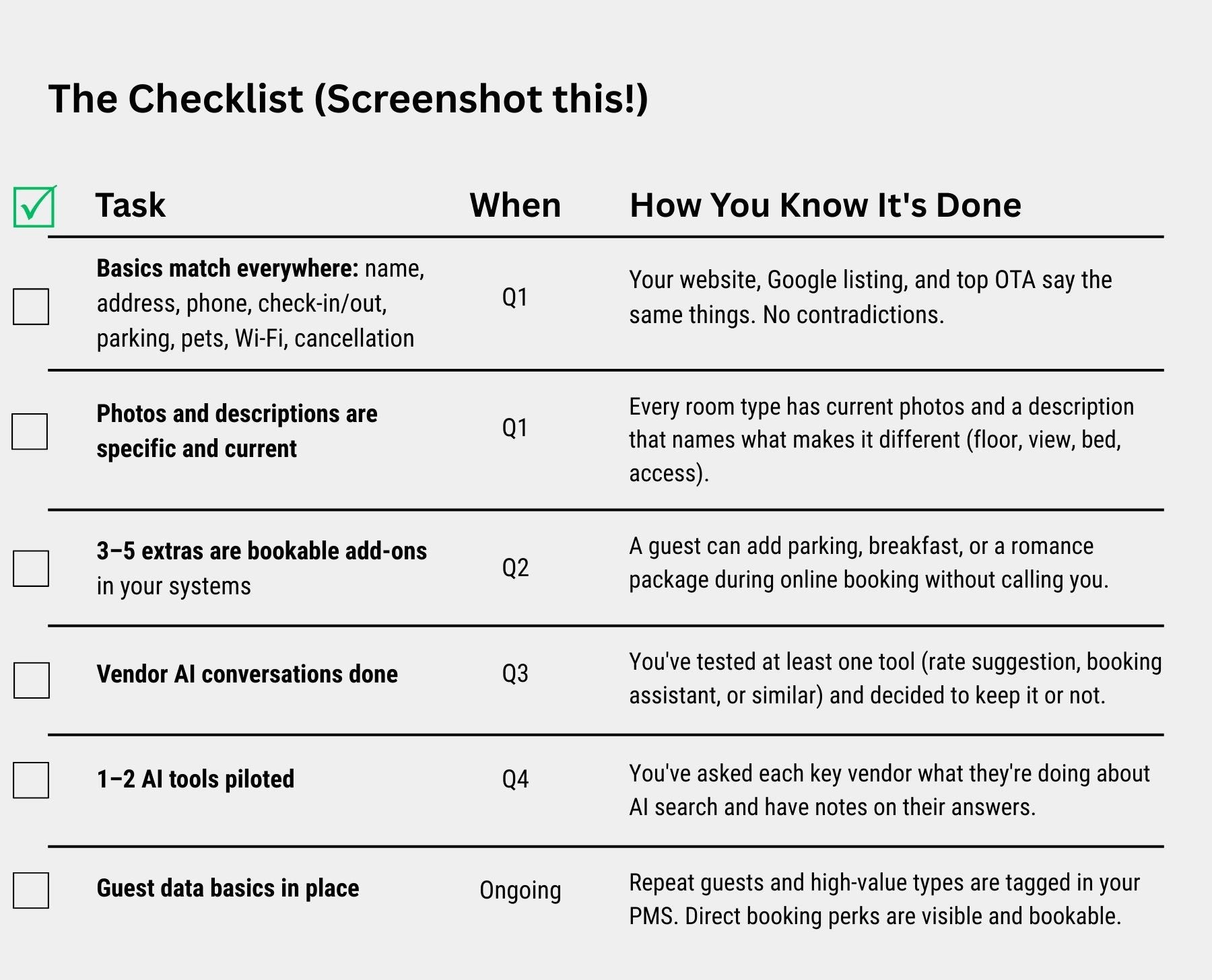
These aren’t predictions. Just notes from what’s already happening. AI is becoming a new layer between you and your guests, and coherent, matching information is a lever you control for staying visible in that layer.
You don’t need to learn AI. You just need your hotel information to be easier to read.
Own that part, and Google finally has something real to work with.
Want a quick AI visibility check? Send me your hotel website and your Google listing. I’ll point out the first contradiction a guest would see, and that AI would amplify.
Quick FAQs
How will AI search affect my small hotel? AI tools are becoming the first gatekeeper between guests and your property. Accurate, complete information will matter more than ever for whether you show up in recommendations.
What is the minimum I should do in the next 12 months? Align your basics across channels, refresh room descriptions and photos, turn 3–5 extras into bookable add-ons, and ask your core vendors how they’re preparing you for AI-driven search.
Do I need new tech to prepare for AI search? Not right away. You can make meaningful progress by cleaning up your data and content, then using vendor conversations to decide when, or if, new tools are worth it.
Is my booking engine or PMS holding me back? Maybe. The vendor conversation in Step 3 is designed to answer exactly that. If your provider can’t explain how they’re preparing for AI-driven distribution, that’s useful information for your next renewal decision.
How do I know when my information is “clean enough”? If your website, Google listing, and top OTA describe the same room the same way, same bed type, view, and inclusions, you’re in better shape than most independents. Start there.
Before adding another AI tool, make sure your basics match up.
Clean facts and a few bookable extras will do more right now than chasing the shiny stuff.