

The 3 Touchpoints That Make or Break the Booking
Guests Feel the Mismatch Before They Can Explain It

(Happy New Year Slipped this one to Friday—figured your Thursday had enough champagne.)
Your OTA listing, your website, and your inquiry response are often having three different conversations with the same guest.
Guests notice. They can’t always name it, but they feel it. Something’s off. And once they feel it, the decision starts to tilt away from you.
So they do what people do when they’re unsure: they keep it simple.
They book somewhere else. Or they book with you, but they spend less than they would have.
“Fine” Is the Most Expensive Word in Hospitality
You already know guests run their own little checklist before they book: Safety, Signal, Story.
Most properties miss on Signal. Guests don’t see themselves there, so they quietly move on.
What makes this tricky: your metrics won’t shout about it.
Bookings still come in. Dashboards still look fine. On paper, nothing’s on fire. But underneath, something leaks. Guests who should have booked didn’t. Guests who did book spent smaller than they could have.
The cost of “fine” shows up in places you don’t always watch:
Fewer add‑ons
Shorter stays
Weaker loyalty
Guests who never refer you
Lifetime value that quietly shrinks
That squeeze is almost invisible. Until you notice how much money never quite moves.
"Every mismatch costs you trust. And trust, once lost, doesn't announce itself. It just leaves."
When your listing says one thing, your website says another, and your inquiry response says a third, guests don’t push through the confusion. They conserve energy. They default to clarity. They choose what feels obvious and skip what feels uncertain.
That’s not price resistance. That’s clarity resistance.
And when clarity is missing, independents feel it first. There’s no brand halo doing the heavy lifting. No loyalty program smoothing over doubt. Every unclear moment quietly redirects money elsewhere.
The Fix Is Smaller Than You Think
The fix isn’t more touchpoints. It’s aligned touchpoints.
Three moments carry most of the weight. Everything else is reinforcement.
These three happen before trust has had time to build. That’s why they matter so much:
Your OTA listing (where guests first find you)
Photos, headline, first paragraph, reviews. Guests decide in seconds whether to keep reading or bounce.Your website or direct booking page
Guests who make it here are ready to book. They’re looking for confirmation that what they saw on the OTA is real and still for them.Your inquiry response or booking confirmation
This either seals the decision or reopens doubt.
When all three pass Safety, Signal, and Story—and all three say the same thing—guests stop comparing. They stop hesitating. They move through with more confidence.
Here’s a pattern you might recognize.
A 30‑room boutique property in a walkable neighborhood lists itself as “perfect for everyone.” Signal: zero. They rewrite with one clear lens: creative professionals who need a quiet place to focus. Same photos. Same rates. Same location. Within a few weeks, weekday bookings from that segment start to climb. The right guests begin to self‑select in.
That wasn’t a rebrand. It was alignment.
What Most Properties Have vs. What Actually Converts
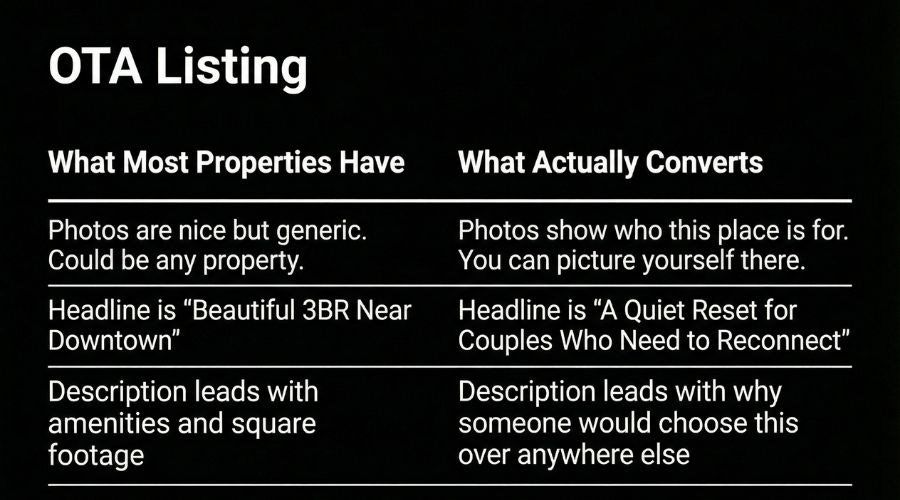

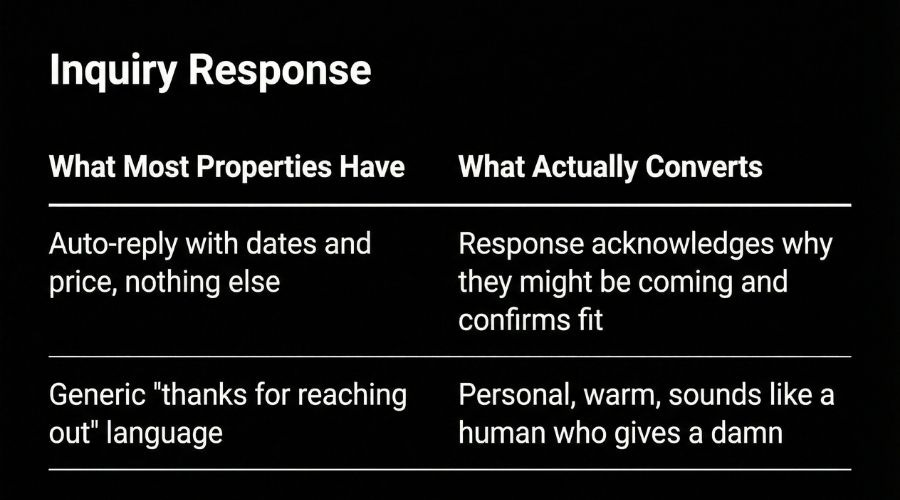
The 3-Touchpoint Audit
You can run this in under an hour.
Step 1
Screenshot your OTA listing, your website homepage, and your most recent inquiry response. Put all three in front of you.
Step 2
Score each one on Safety, Signal, and Story.
0 = Missing or broken
1 = Present but weak
2 = Strong and aligned
A 1 is not a 2.
Step 3
Check for consistency across all three.
Do these look like they belong to the same property?
Is the visual tone consistent?
Is the voice consistent?
Would your ideal guest feel recognized at every step?
If not, you’ve found the leak.
Step 4
Fix the lowest scores first. Any touchpoint scoring below a 2 is your priority. Don’t optimize what already works.
The AI Prompt for Your Audit
Copy this. Paste it into ChatGPT or Claude. Add your content. Fifteen minutes, full audit.
I’m going to paste three pieces of content from my property: my OTA listing, my website homepage, and my standard inquiry response. Evaluate each one against these three criteria:
Safety: Does this feel professional, clean, and trustworthy? Any red flags?
Signal: Does this clearly communicate who this property is for? Would the ideal guest see themselves here?
Story: Does this reinforce something beyond utility? Is there meaning or narrative present?
Score each criterion 0-2 for each touchpoint (0 = missing, 1 = weak, 2 = strong).
Then tell me:
Where are the gaps?
Where are the inconsistencies between touchpoints?
What specific changes would improve the lowest scores?
When Guests Stop Guessing, They Start Spending
When you fix Signal, you usually see it in the quality of inquiries first.
Fewer price-only questions.
Fewer “just checking” messages that go nowhere.
More guests who message already knowing they want to stay.
The bigger shift shows up after they arrive.
When guests book with confidence, they spend with confidence. They don’t narrow. They don’t default to the safest option. They ask questions. They try things. They stay longer at dinner. They book the experience instead of just browsing it.
The money was there. The clarity wasn’t.
When your touchpoints align, you stop losing guests to confusion before they book and stop losing spend to uncertainty after they arrive.
Put It to Work This Week
Today, screenshot your OTA listing and score it on Safety, Signal, and Story. That’s it. Start there.
Tomorrow, do your website. The next day, your inquiry response.
By the end of the week, you’ll know exactly where guests are slipping out of the funnel and why—without adding any new tools or campaigns.
Your guests already have a system for deciding. Now you have a system for passing it.
Kay
P.S. Tight spending doesn’t announce itself as a problem. It just quietly compounds. Start with your OTA listing. That’s where intent is highest and confusion is most expensive. Hit reply and tell me which touchpoint scored lowest. I’ll tell you where to start.